A Journey Through Jordan: What the Trip Really Feels Like
Updated: August 2026
Jordan can look deceptively simple when you first see it on a map. The country is compact, the names that dominate most first-time travel plans are easy to recognize, and the distances between major regions seem manageable enough that you might imagine the journey as a neat progression from one famous place to another.
Traveling through Jordan feels rather different.
The country changes character surprisingly quickly once you begin moving through it, and those transitions become part of the experience rather than empty hours separating attractions. Amman gradually gives way to quieter roads and broad landscapes, archaeological remains appear in places where modern life continues around them, cultivated areas become increasingly sparse, sandstone begins to dominate the scenery farther south, and eventually Wadi Rum removes much of the visual clutter altogether.
Somewhere during those changes, Jordan stops feeling like a collection of places you researched before leaving home.
It begins to feel like a journey.
That distinction matters because many of the memories people carry away from Jordan are not necessarily the ones they expected to collect. Petra may indeed become the photograph everyone wants to keep, yet a conversation over coffee, the changing landscape through a vehicle window, the silence after sunset in the desert or an unplanned stop along the road can become equally attached to the way the country is remembered.
Jordan rewards travelers who notice what happens between the famous places.
The First Surprise Is How Quickly Amman Begins to Change
Amman can initially make Jordan feel more urban than many first-time visitors expect, particularly for travelers whose mental image of the country has been shaped primarily by photographs of Petra and Wadi Rum.
The city has its own rhythm, shaped by hills, traffic, neighborhoods, restaurants, shops and historical layers that coexist with ordinary contemporary life. Yet one of the interesting things about beginning a wider Jordan journey in Amman is how quickly that urban density begins to loosen once you travel beyond it.
Buildings become less continuous, the horizon opens and the relationship between settlements and landscape starts to change.
You do not need to be heading toward one particular attraction to notice the transition.
That first departure from Amman often provides an early reminder that Jordan is not simply a desert country containing an unusually large city in the north. Geography changes repeatedly as you move through it, and the landscapes around the capital belong to a different visual world from those waiting farther south.
Amman therefore works as more than a gateway.
It gives you something to leave behind, which makes the transformation that follows much easier to notice.
Jordan Makes More Sense When You Look Out of the Window
Road time is frequently treated as the uninteresting part of travel, the necessary interval between the hotel you have left and the attraction you paid to visit.
Jordan makes that attitude surprisingly difficult to maintain.
The landscape changes too often.
Roads move through populated areas, agricultural land, rolling terrain, increasingly arid stretches and eventually landscapes where geology seems to take over almost completely. Small communities appear and disappear, roadside businesses provide brief glimpses of ordinary life, and the relationship between buildings and open space shifts as the journey continues.
None of these moments needs to become a formal sightseeing stop.
In fact, their value partly comes from not being organized as attractions.
Looking through the window allows the country to connect itself. You begin to understand that Petra, Amman and Wadi Rum are not isolated experiences that happen to share a national border, but places positioned within a landscape whose character keeps evolving as you travel.
Sleeping through every transfer may therefore be efficient recovery.
You may also miss part of Jordan.
History Refuses to Arrive in the Correct Order
Travel books naturally organize history chronologically because that is the easiest way to explain several thousand years without creating confusion.
Jordan does not present itself so politely.
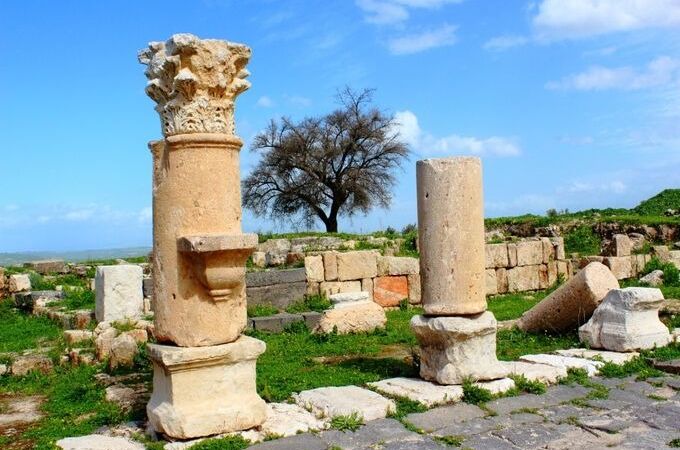
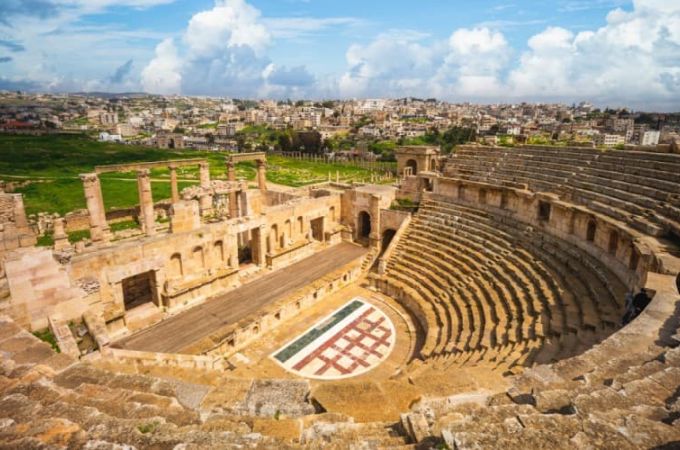
A traveler can encounter Roman urban remains, Byzantine mosaics, Islamic architecture and Nabataean engineering within a journey where the geography rather than the historical timeline determines what comes next. Modern towns and villages continue around ancient places, while archaeological landscapes that appear visually isolated may once have been connected to complex trade and settlement networks.
This disorder is one of the pleasures of traveling through the country.
You gradually stop expecting one historical period to finish before another begins.
A good guide can help make sense of those layers without turning the journey into a continuous lecture, particularly because understanding why a site mattered often provides more value than memorizing the date when something was constructed.
For travelers who are not naturally fascinated by archaeology, this distinction is important.
Jordan's history becomes much easier to enjoy when it is connected to people, water, trade, religion, geography and survival rather than presented as a succession of rulers whose names everyone will forget by dinner.
The Country Feels Larger Than the Kilometer Count Suggests
Jordan is relatively compact, which makes it possible to connect very different environments without the enormous internal journeys required in some countries.
Yet the experience can feel much larger than the distances imply.
This happens because the scenery changes enough to create psychological distance.
An hour spent driving through a landscape that gradually transforms does not feel the same as an hour on a motorway surrounded by essentially identical scenery. By the time you reach another region, the environment may have changed sufficiently that yesterday's hotel feels much farther away than the map suggests.
That gives a Jordan journey a useful sense of progression.
You can cover meaningful geographical ground without spending entire days in transit, while still experiencing the feeling that the trip is moving somewhere rather than circling around a single base.
Travelers exploring Jordan through Private Journeys Across Jordan can take advantage of this particularly well when the route allows enough time for the transitions to remain visible instead of treating every road as something to complete as quickly as possible.
Sometimes the journey earns its place beside the destination.
Madaba Can Change the Way You Begin Looking at Jordan
Certain places are memorable because they overwhelm you.
Others quietly change what you start noticing afterward.
Madaba can have that effect, particularly when mosaics and historical religious geography become part of the visit. The experience encourages a different kind of attention from the monumental scale associated with some of Jordan's better-known archaeological sites.
Instead of asking how large something is, you begin looking more closely.
Detail matters.
Fragments matter.
The relationship between an ancient representation and the geography you are physically traveling through can make the wider journey feel unexpectedly connected.
This is why Jordan works well when travelers resist ranking every stop according to fame. A smaller historical encounter may prepare you to understand something later, while an apparently minor place can remain memorable precisely because expectations were lower.
Not every experience needs to compete with Petra.
Jordan becomes more interesting when you stop asking it to.
The King's Highway Feels Different When You Stop Treating It as a Shortcut
Some roads exist primarily to move people efficiently.
Others help explain the country they cross.
Traveling through parts of Jordan's historic north-south landscape can reveal changes in elevation, settlement and terrain that disappear when transportation is judged entirely by the fastest possible arrival time.
This does not mean every journey should deliberately take the longest road available.
Travel time still matters, particularly on a holiday where each day has value. Yet there are occasions when choosing a slower route adds something that cannot be recreated by arriving earlier at the hotel.
The landscape becomes part of the narrative.
You see how geography separates and connects places, why commanding positions mattered historically and how quickly the environment can change within a relatively compact country.
A road can therefore become more than infrastructure.
Sometimes it is the chapter that makes the destinations on either side of it make sense.
Somewhere on the Way South, Jordan Begins to Feel Quieter
The transition toward southern Jordan is not a dramatic border where one landscape ends and another begins.
That gradualness is precisely what makes it interesting.
Urban density diminishes, open spaces become more prominent and the visual scale begins shifting toward the landscapes many travelers associated with Jordan before arriving. By the time sandstone and more arid environments become dominant, the change feels earned because you have watched it happen.
This can also affect the rhythm inside the vehicle.
Conversations become intermittent. People begin looking outside more often. The journey requires less explanation because the landscape itself has become interesting enough to hold attention.
For travelers arriving directly at famous sites without experiencing these transitions, individual destinations can still be extraordinary.
What is missing is the sense of arrival.
Traveling overland gives places context because you remember what the country looked like before they appeared.
Petra Is the Place You Think You Already Know
Few first-time visitors arrive at Petra without knowing what the Treasury looks like.
You may have seen it in travel documentaries, advertisements, films, social media posts and photographs so many times that part of the surprise seems to have been removed in advance.
Then you approach it on foot.
The difference between recognizing a building and experiencing an arrival becomes immediately obvious.
The landscape controls what you can see, the route determines how the archaeological city reveals itself, and the physical act of moving toward something familiar changes the emotional response to it.
That is why Petra should not be reduced to a photograph that needs to be collected.
The famous view matters, but the experience surrounding it is what turns recognition into memory.
The same principle applies throughout Jordan.
Travel images usually remove the road, the weather, the voices around you, the effort required to reach a viewpoint and the minutes before something appears.
Those supposedly secondary elements are often what make being there different from having already seen it.
Petra Also Teaches You to Stop Asking Where the Main Attraction Is
Travelers accustomed to monuments with a defined entrance, central attraction and exit can initially approach Petra with the same mental model.
The site resists it.
Once the first famous images have been encountered, the wider landscape begins competing for attention, and the distinction between archaeology and geography becomes increasingly difficult to maintain.
This is not the place to turn a journey narrative into a checklist of Petra monuments; that belongs in a dedicated destination guide.
What matters here is the way Petra changes the traveler's relationship with Jordan.
Earlier historical sites may have felt like places positioned within the landscape. Petra makes the landscape itself part of the historical experience.
Afterward, it becomes harder to look at southern Jordan merely as scenery.
You begin wondering how people moved through it, where water came from, what routes connected communities and why certain places developed where they did.
The country starts asking better questions.
Wadi Rum Removes Almost Everything the Previous Days Added
By the time many travelers reach Wadi Rum, Jordan has already provided cities, archaeological explanations, religious history, roads, ruins, restaurants, hotel check-ins and a growing collection of names and dates.
Then the desert strips much of that away.
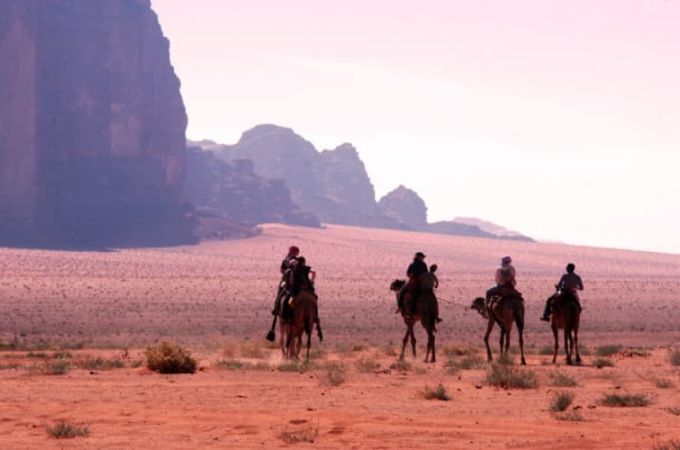
The visual vocabulary becomes simpler: rock, sand, sky, light and distance.
That simplicity is powerful precisely because of what came before it.
Wadi Rum does not need to compete with Petra through another concentration of monuments, nor does it need to provide another historical narrative at the same intensity. Its role within a longer journey can be almost the opposite.
The traveler looks farther and listens less.
As the light changes, familiar rock formations can appear completely different, while distances become difficult to judge because the landscape offers relatively few everyday objects for scale.
An overnight can deepen that change of rhythm because the desert continues after the organized excursion has ended.
There is no requirement to fill every hour.
Wadi Rum often becomes most memorable when the itinerary temporarily stops trying to entertain you.
The Quietest Hour May Not Appear Anywhere on Your Itinerary
Professional travel planning naturally focuses on things that can be confirmed.
Transfers have times. Hotels have names. Guided visits have meeting points. Activities have descriptions.
Some of the most memorable travel experiences are impossible to schedule with that precision.
It may be the period after dinner when conversation becomes quieter. A coffee stop that lasts longer than expected. A roadside view where the driver stops for a few minutes. An early morning before the rest of the hotel seems awake, or an evening when you walk without trying to reach another attraction.
These moments matter in Jordan because so much of the formal itinerary can be historically dense.
Unstructured time gives the information somewhere to settle.
Travelers sometimes remove these gaps when customizing a journey because blank space looks like poor value on paper.
Once the trip begins, those same gaps can feel luxurious.
The Dead Sea Can Feel Like an Intermission
A journey containing several archaeological sites and changing landscapes eventually benefits from an experience that requires very little interpretation.
The Dead Sea can provide exactly that.
You do not need a long historical explanation before understanding that the water behaves strangely. Floating becomes immediate, physical and slightly surreal, particularly after days spent processing civilizations, architecture and geography.
Its role in the journey can therefore be more valuable than its duration suggests.
The Dead Sea does not need to become another major sightseeing campaign. Depending on the itinerary, it can simply interrupt the intellectual intensity of the trip and allow the pace to change.
A resort stay can extend that pause, while a shorter visit may be enough for travelers whose schedule is tighter.
The important point is not how many hours are spent there.
It is how different those hours feel from the ones surrounding them.
The Landscape Changes the Meaning of Distance Again Near the Desert
Desert landscapes play strange games with scale.
A formation that appears relatively close may be much farther away than expected, while vehicles moving across open ground can seem tiny enough to reveal just how large the surrounding space actually is.
After several days traveling through Jordan, this can alter your sense of the country's size once again.
The map still says the distances are manageable.
The desert says something else.
This tension between geographical compactness and visual scale is part of Jordan's appeal. The country allows travelers to move efficiently between major regions while repeatedly creating the sensation of having entered a completely different environment.
It is one reason a journey through Jordan can feel substantial without requiring an extremely long holiday.
The experience is concentrated, but it does not necessarily feel compressed.
Free Evenings Reveal the Jordan That Guided Days Cannot
Guided sightseeing is enormously useful in a country where history and archaeology benefit from context, but a journey consisting entirely of organized hours can create an incomplete impression.
Free evenings offer another perspective.
Restaurants become places where people are actually eating rather than scheduled lunch stops. Streets are encountered without somebody explaining what comes next. You notice families, cafés, shops, traffic and the ordinary rhythms that continue after historical sites have closed.
These experiences may appear less significant when you are planning from home because they cannot be listed neatly under “tour highlights.”
They help prevent Jordan from becoming a historical stage set.
This is a modern country whose residents are not supporting characters in somebody else's archaeological holiday, and leaving a little time without a guide can make that reality much more visible.
Travelers considering Explore Jordan with Local Experts should therefore resist the temptation to interpret professional planning as continuous scheduling.
Good organization can include time when nothing has been organized at all.
Food Begins to Carry Memories From One Place to Another
Meals have an interesting role during a journey because they repeat daily while the surroundings keep changing.
At first, unfamiliar dishes may require explanation. Several days later, you recognize what is arriving before anybody tells you.
Preferences develop.
You begin looking for something you enjoyed earlier, comparing versions of familiar dishes or noticing that a meal in a family-run restaurant feels different from one served in a hotel.
Food gradually becomes one of the threads connecting regions that otherwise appear quite different.
This is especially valuable during a journey where historical periods and landscapes change rapidly. Lunch provides continuity. Bread arrives, dishes are shared, tea or coffee follows, and the travel day briefly becomes ordinary again.
Not every meal needs to become a culinary event.
In fact, the repeated everyday meals may tell you more about how the country begins feeling familiar.
Jordanian Hospitality Is Best Understood Through Small Encounters
“Hospitality” appears so frequently in travel writing that the word can lose meaning.
It becomes more convincing through specific moments.
A conversation that lasts longer than expected, tea offered without ceremony, somebody asking where you are from and genuinely waiting for the answer, or a guide explaining something about ordinary family life can reveal more than a paragraph describing Jordanians as welcoming.
Travelers should also allow these interactions to remain normal human encounters rather than treating every friendly exchange as a cultural performance.
People may be curious about you just as you are curious about them.
Not every conversation needs to produce a profound insight into Jordanian society.
Sometimes it is simply pleasant.
That ordinariness can be refreshing during a journey dominated by extraordinary historical places.
A Guide Changes the Journey Most When You Stop Noticing the Guiding
Good guiding does not mean continuous talking.
The strongest guides understand when context is necessary and when the traveler needs time to look.
This balance matters particularly in Jordan because the amount of history available at archaeological sites can easily overwhelm a visitor who is trying to remember every civilization, century and architectural term.
A knowledgeable guide can establish enough context that the place becomes understandable, then allow the site itself to take over.
The same applies on the road.
Stories about contemporary life, geography and local customs can make the journey richer without converting every kilometer into a lecture.
Travelers who normally prefer exploring independently may therefore find local guiding particularly valuable at selected points rather than assuming they must choose between being guided everywhere or nowhere.
Interpretation works best when it opens the destination instead of standing between you and it.
Not Every Ruin Needs to Become Your Favorite Ruin
Jordan contains enough historical material that travelers sometimes feel obligated to remain equally impressed throughout the journey.
That is unrealistic.
One archaeological site may fascinate you because of its scale, another because of a particular story, while somewhere historically significant may simply fail to connect emotionally.
Travel is allowed to work that way.
Trying to rank everything can also obscure how different sites contribute to the wider journey. A smaller archaeological stop may provide context that makes a later place more understandable, while a site you would never describe as the highlight may still contain one detail you remember years later.
This is another reason to avoid treating Jordan as a countdown of “must-see” attractions.
Must-see lists imply that the experience can be standardized.
Jordan becomes more personal once you accept that your favorite moments may not match anybody else's list.
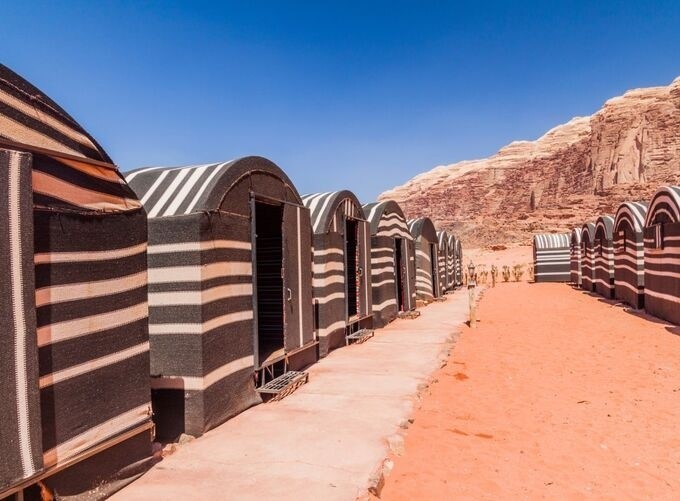
The Journey Becomes More Interesting When You Occasionally Stop Photographing It
Jordan is exceptionally photogenic, which creates a predictable problem.
A traveler can spend so much time trying to preserve the experience that looking through a screen becomes part of almost every memory.
Petra invites photographs. Wadi Rum almost demands them. The Dead Sea produces the obligatory floating image, while viewpoints throughout the country create another reason to reach for the phone.
Take the photographs.
Then put the camera away occasionally.
Stand somewhere for five minutes without trying to improve the composition. Watch how the light changes or how people move through the landscape. Listen to the guide without recording the explanation you will probably never replay.
Photographs are excellent at preserving appearance.
They are much less effective at preserving atmosphere.
You need to experience that part directly.
The Journey Home Begins Before You Reach the Airport
Near the end of a trip, something subtle changes.
Places that were unfamiliar several days earlier have become reference points. Foods no longer need explanation. You recognize road signs, understand how hotel mornings work and have developed small routines that would have seemed foreign at the beginning.
Then the journey starts reversing psychologically before it ends physically.
You begin thinking about luggage, the departure flight and what you will tell people at home. Photographs are reviewed. Somebody asks which place was your favorite, and you discover that answering is more difficult than expected.
This is where Tailor-Made Jordan Experiences have an advantage over journeys designed simply to maximize attraction count: a good route leaves enough variation and breathing room for the country to become more than a sequence of completed visits.
The most successful journey is not necessarily the one where you saw everything possible.
It is the one where the places stopped feeling interchangeable.
You Remember Jordan in Scenes Rather Than Itinerary Order
Several months after returning home, the itinerary begins losing its authority.
You may forget whether a particular stop happened on the fourth or fifth day. The exact departure time disappears, and the hotel sequence becomes less important than it seemed while you were packing.
What remains is more fragmented and more personal.
The first glimpse of something through the Siq. A desert evening. A conversation in the vehicle. The strange physical sensation of floating. The color of the landscape during a long drive. A meal you had not expected to enjoy as much as you did.
That is perhaps the most useful way to understand a journey through Jordan.
The country is compact enough to connect its major regions comfortably, yet varied enough that each transition changes the mood of the trip. History provides depth without being the only story, landscapes repeatedly alter the pace, and ordinary moments stop the famous ones from becoming a checklist.
You arrive knowing the names.
You leave remembering the spaces between them.
12 Questions About What Traveling Through Jordan Actually Feels Like
1. Does traveling across Jordan feel rushed because the country is relatively small?
It can feel rushed when an itinerary uses the country's manageable distances as an excuse to schedule something at every possible stop. With sensible pacing, however, Jordan's compact geography becomes an advantage because substantial changes in landscape and atmosphere can occur without spending entire days simply reaching the next region.
2. Is the scenery between Jordan's major destinations actually worth paying attention to?
Yes, particularly if you enjoy seeing how geography changes rather than viewing transportation as dead time. The scenery evolves noticeably between regions, and watching settlements, terrain and vegetation change provides context that is difficult to gain when individual destinations are experienced as isolated sightseeing stops.
3. Will Petra still be impressive if I have already seen hundreds of photographs?
Photographs reveal what famous parts of Petra look like, but they cannot reproduce the physical approach, scale, surrounding landscape or experience of moving through the archaeological area. Familiarity may remove some visual surprise while leaving the actual sense of arrival almost completely intact.
4. Does Jordan feel very touristy once you leave the famous archaeological sites?
Tourism is naturally visible around major attractions, although much of the time spent traveling between them passes through places where everyday Jordanian life continues without being organized around visitors. Free time outside formal sightseeing can also provide a broader impression of the contemporary country.
5. Is Wadi Rum still worthwhile if I am not interested in adventurous desert activities?
It can be, because the appeal of Wadi Rum is not limited to adventure. Travelers who enjoy landscape, photography, changing light, quiet evenings or simply experiencing an environment dramatically different from the rest of their journey may find the desert memorable without needing an activity-heavy program.
6. Do Jordan's archaeological sites eventually begin to feel repetitive?
They can if every visit is approached as another collection of ruins requiring dates and names to be remembered. Variety in historical periods, landscapes and interpretation helps enormously, while alternating archaeology with desert, urban life, food and slower experiences prevents the journey from becoming intellectually monotonous.
7. Is Jordan interesting for someone who is not particularly enthusiastic about history?
Yes, provided the trip is not designed entirely around archaeological explanation. Landscapes, food, contemporary city life, the desert, the Dead Sea, road journeys and everyday encounters can give the country considerable variety even when ancient history is not the traveler's primary motivation.
8. Will I regret sleeping during the longer road journeys?
Probably not every time, particularly when you genuinely need the rest, although watching at least some of the landscape transitions can make the wider journey easier to understand. Jordan's changing scenery gives road travel more experiential value than the kilometer count alone might suggest.
9. Does Jordan feel noticeably different once you leave Amman?
Yes, although the change is gradual rather than immediate. Urban density begins to loosen, landscapes become increasingly prominent and different regions develop distinct visual characters, making the transition away from the capital one of the first moments when the wider geography of Jordan becomes apparent.
10. Are free evenings worth keeping when I could add more sightseeing?
Often they are, especially during a historically dense itinerary. Unscheduled evenings provide opportunities to experience restaurants, neighborhoods and ordinary daily life without another formal explanation, while also giving travelers enough mental space to absorb what they have already seen.
11. Does traveling with a local guide change the experience significantly?
At historically complex places, good guiding can transform impressive remains into understandable environments by connecting architecture with people, geography and events. The best experience usually comes when interpretation provides enough context without occupying every moment, leaving travelers time to observe and develop their own reactions.
12. What tends to surprise first-time visitors most about traveling through Jordan?
Many arrive expecting Petra and Wadi Rum to dominate everything else, then discover that the country's transitions are part of its appeal. The relatively short distances between very different landscapes, the mixture of historical periods and the ordinary moments between scheduled attractions often give the journey more texture than expected.

A travel professional specializing in tailor-made travel planning, guest experience management, and multi-destination tourism operations.
With over 23 years of experience in the travel industry, he designs and manages private and cultural tours for international travelers across Türkiye, Greece, Egypt, Jordan, Morocco, and other destinations.
He has strong expertise in both online and face-to-face guest communication, sales processes, and end-to-end travel operations.
Working closely with hotels, travel agencies, and local partners, he ensures smooth coordination and high-quality travel experiences at every stage of the journey.
His focus is on delivering personalized, reliable, and seamless travel experiences for international guests worldwide.