

Jordan in June: Build the Trip Around the Season
Last Updated: August 9, 2026
June changes the question travellers should ask about Jordan.
Instead of wondering whether the weather is suitable for Petra, Wadi Rum or Amman, it becomes more useful to ask how those places should fit into an early-summer day.
Jordan does not close when temperatures rise. Archaeological sites remain extraordinary, Wadi Rum does not become less dramatic, and Amman continues functioning as a lively capital rather than retreating indoors until autumn. What changes is the amount of physical effort you may want to place into the warmest hours and how carefully you should distinguish between destinations at different elevations.
This makes June less about tolerating summer and more about designing for it.
A good itinerary works with the season so naturally that heat becomes one factor in the journey rather than the subject of every conversation.
June Rewards Better Decisions, Not Greater Endurance
There is no particular achievement in walking through the most exposed part of an archaeological site during the hottest portion of the day simply because your itinerary says you can.
June gives travellers enough daylight to be selective.
Use the morning for the places that require movement, concentration and long periods outside. Let midday absorb lunch, transfers, hotel time or experiences that demand less physical effort. Return to the outdoors later when the character of the day begins changing again.
Different parts of Jordan respond differently to this approach.
| Destination | June Character | Smarter Use |
|---|---|---|
| Amman | Warm but elevated | Cultural touring with flexibility |
| Jerash | Sunny, exposed archaeology | Earlier exploration |
| Petra | Hotter long-distance walking | Prioritise routes |
| Wadi Rum | Dry desert summer | Split active periods |
| Dead Sea | Very warm low elevation | Resort-focused stay |
| Aqaba | Hot Red Sea conditions | Water-led extension |
June is not asking you to remove destinations.
It is asking you to stop treating every hour as equal.
Petra Becomes an Exercise in Choosing Well
During cooler months, ambitious Petra itineraries are easy to imagine.
Treasury, Royal Tombs, Monastery, viewpoints, perhaps another trail if energy remains.
June makes selectivity more valuable.
Petra is too large and too important to reduce to a rushed visit, but that does not mean you need to walk every possible route. Decide which parts genuinely matter before entering and use the cooler morning hours for the most demanding section.
For many first-time visitors, that still means spending a substantial day inside the archaeological city. The difference is that pauses become more deliberate and optional climbs should remain genuinely optional.
Travellers wanting a carefully paced archaeological itinerary can explore Petra summer routes, allowing the visit to reflect both the scale of the site and the realities of early-summer walking.
You came to experience Petra.
Not defeat it.
Amman Becomes More Useful Than You Might Expect
Summer itineraries often focus increasingly on Petra, Wadi Rum and the Red Sea, but June is a good month to recognise Amman's practical advantage.
Elevation matters.
The capital generally has a different summer character from the Dead Sea or Aqaba, and its mixture of outdoor and indoor experiences gives the day flexibility. Archaeological sites can occupy earlier hours, while museums, food, cafés and neighbourhood exploration can fill other parts of the schedule.
This also gives travellers a more complete introduction to contemporary Jordan.
A journey that begins immediately with a long road transfer towards Petra may reach the country's most famous attraction sooner, but it loses some context along the way.
Those wanting a broader opening can include Amman cultural tours, giving the capital enough time to become a destination rather than merely an arrival point.
Wadi Rum Should Have a Desert Schedule
Wadi Rum is where fighting the season makes the least sense.
The desert already has its own rhythm.
June simply makes it more obvious.
Earlier hours and later afternoon are better suited to active exploration, while the middle of the day can become slower. A 4x4 journey allows you to experience a large area without requiring continuous physical exertion, and shaded stops can interrupt the exposed portions naturally.
Then evening changes everything.
As the light softens, Wadi Rum becomes less about managing the day and more about watching the desert transform. Sunset, dinner and the atmosphere around camp justify staying after the sightseeing vehicles begin leaving.
Travellers interested in that fuller experience can consider Wadi Rum camps, choosing accommodation according to comfort and experience rather than treating the desert as a short excursion.
The Dead Sea Is Not Where You Go for a Long Walk
This sounds obvious.
It is still worth saying.
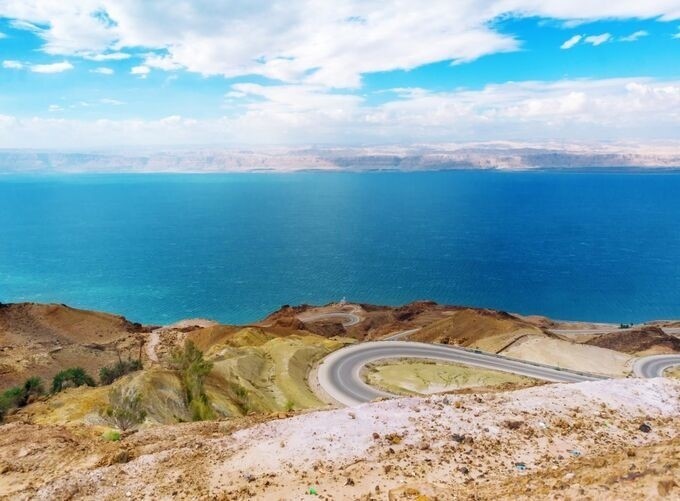
By June, the Dead Sea's extremely low elevation contributes to very warm conditions, so the destination makes more sense when the itinerary uses it for what it does particularly well: water, resort facilities, wellness and downtime.
Do not arrive with an ambitious afternoon sightseeing programme simply because there is an empty space before dinner.
Let the empty space survive.
A slower stay through Dead Sea resorts can work particularly well after Petra and Wadi Rum, when the journey has already accumulated plenty of walking and movement.
The Dead Sea does not need another activity attached to it to justify the night.
Aqaba Changes the Purpose of the Day
June in Aqaba is warm enough that the Red Sea should become part of the itinerary's logic rather than scenery outside the hotel window.
Diving, snorkelling and water-based activities can provide a completely different rhythm after several cultural days, while resort time allows the final portion of the journey to become intentionally less demanding.
Travellers interested in marine experiences can consider Aqaba marine trips, but timing and current conditions still matter for any outdoor activity.
Aqaba works best when you want what Aqaba offers.
Adding the city to a short itinerary merely because it appears on a list of Jordan highlights usually creates another transfer without enough time to enjoy the coast.
Summer Changes What “Full Day” Should Mean
A full day does not have to mean continuous sightseeing from breakfast until dinner.
June exposes the weakness in that definition.
A full Petra day might include an early entrance, several substantial hours of exploration, a proper break and a slower final section. A full Wadi Rum day may combine morning desert exploration, a quiet middle period and an excellent evening at camp.
Even Amman can benefit from alternating outdoor and indoor experiences rather than completing archaeological sites consecutively.
Travellers considering broader Jordan summer tours should therefore look at rhythm as carefully as destination count.
How many nights you spend somewhere matters.
How you use the hours matters just as much.
June Works Better When the Itinerary Stops Showing Off
Some itineraries seem designed to demonstrate how much can theoretically fit into one week.
Amman.
Jerash.
Petra.
Dana.
Wadi Rum.
Dead Sea.
Aqaba.
Technically possible is not the same as enjoyable.
June makes that distinction particularly important because every additional transfer and exposed sightseeing stop consumes energy that could have been used somewhere more meaningful.
Choose the places you care about most and give them the right part of the day.
Perhaps that means three hours more in Petra and one attraction less elsewhere. Maybe Wadi Rum receives an overnight stay instead of a rushed afternoon. Perhaps Aqaba disappears completely because your eight-day trip already has enough geography.
Early summer does not reduce Jordan's possibilities.
It makes priorities more important.
That is June's real advantage for thoughtful travellers.
The season forces you to ask what you actually came to see.
Petra in June Is Better When You Stop Trying to Complete It
Petra creates a peculiar kind of ambition.
You arrive knowing about the Treasury, then discover the Monastery. Someone mentions a viewpoint. The Royal Tombs appear on the map. Another trail promises a remarkable panorama, and suddenly a visit to an ancient city begins resembling a challenge in which success is measured by how little you leave unseen.
June is a good month to abandon that idea.
The archaeological site is vast, the terrain requires genuine effort, and increasing summer heat changes the cost of every additional kilometre. Trying to complete Petra rarely creates a deeper experience.
Choosing well does.
Start With the Experience You Actually Want
Before deciding on a route, ask what attracted you to Petra.
For some travellers, it is the classic sequence: walking through the Siq, seeing the Treasury emerge between the rock walls and continuing through the main archaeological area.
Others want the Monastery.
Some are particularly interested in Nabataean history and architecture, while active travellers may care more about elevated routes and the wider landscape.
Those interests should determine the day.
Do not automatically select the longest itinerary because it appears more comprehensive. A shorter route explored with curiosity can be far more rewarding than an ambitious one completed while watching your water bottle and wondering how far the exit is.
The Treasury Is the Beginning, Not a Reason to Hurry
The Treasury creates one of Jordan's most recognisable travel moments, which means visitors naturally spend time there.
Let them.
There is no need to rush away simply because someone advised you that the “real Petra” begins farther inside. The Treasury is part of the real Petra, just not all of it.
Once you continue beyond it, the archaeological landscape opens gradually. Tombs, remains of temples, carved façades and mountain scenery begin explaining the scale of the ancient city.
This central route can already produce a substantial experience without requiring every major climb.
That matters in June because the difference between seeing more and enjoying more becomes increasingly obvious as the day progresses.
The Monastery Should Be a Choice
The Monastery is magnificent.
It also requires effort.
Reaching it involves a long route with many steps, and travellers should evaluate the walk according to fitness, current conditions and the rest of their day rather than treating it as mandatory.
If the Monastery is one of your priorities, organise the Petra visit around it.
Protect your energy. Take sensible breaks. Avoid adding every possible viewpoint beforehand simply because you happen to pass a trail sign.
If it is not a personal priority, leaving without seeing it does not mean you failed at Petra.
Travel has enough unnecessary guilt already.
You do not need archaeological guilt too.
Viewpoints Have a Hidden Cost
Photographs make viewpoints appear wonderfully simple.
There is the Treasury below you.
There is the camera.
What the photograph often excludes is the climb.
Elevated routes can add significant time, distance and sun exposure to a June visit. Before following one, understand where the trail goes, how demanding it is and whether the experience justifies the effort for you personally.
A viewpoint that is perfect for one traveller may be completely unnecessary for another.
This is particularly important when social media has influenced your expectations. Some images create the impression that a particular angle is an essential part of seeing Petra.
It isn't.
Petra remains extraordinary from ground level.
Build the Day Around One Major Addition
For many June visitors, a useful approach is to treat the main archaeological route as the foundation and choose one significant extension.
That might be the Monastery.
It might be an elevated route.
It might simply mean spending considerably more time exploring tombs and central areas rather than adding another strenuous climb.
One major addition creates focus.
Two or three can create a day in which the final hours are determined more by physical endurance than archaeological interest.
June has enough daylight to make an overloaded itinerary technically possible.
That does not make it necessary.
Know When the Visit Has Been Enough
This is one of the hardest travel skills.
You have paid for the trip, travelled a long distance and reached one of the world's great archaeological sites. Naturally, you want to use every possible minute.
But there is a point when additional sightseeing stops adding much.
You stop noticing details.
Another façade becomes another façade.
The guide explains something interesting and you realise you were thinking about cold water.
That is the moment to slow down or finish.
Leaving Petra while you still want a little more is not a bad outcome.
It may be the reason the parts you did see remain distinct in your memory.
June Turns Selectivity Into an Advantage
Summer conditions make prioritisation necessary, but that necessity can improve the experience.
You begin asking better questions.
Which monument genuinely interests me?
Do I want the Monastery because I care about seeing it, or because everyone says I should?
Would another climb improve the day, or would I rather spend that time looking properly at the archaeological area already around me?
Those questions are useful in every season.
June simply makes them harder to ignore.
Petra is too large to complete and too important to rush.
Choose the parts that matter, give them enough time and let the rest remain a reason to be curious about what you did not see.
June Heat Can Be Easy to Underestimate
Dry heat has a strange advantage.
It can feel more manageable than humid weather, particularly when you are standing in shade or a breeze appears. Clothes may not feel damp, and you can spend several hours outside without experiencing the heavy atmosphere associated with more humid destinations.
That comfort can be misleading.
You are still walking through exposed archaeological sites, moving across desert landscapes and spending substantial time under strong sun. Because perspiration evaporates quickly in dry conditions, you may not always notice how much fluid you are losing.
June therefore rewards small habits rather than dramatic precautions.
Drink regularly, use shade when it appears and do not wait until you feel exhausted before taking a break.
Carry Water Before You Need It
Petra teaches this lesson quickly.
You begin the morning comfortably, perhaps carrying a small bottle because shops and refreshment points exist along parts of the route. Several hours later, you may be considerably farther from the entrance than expected and considering another extension to the walk.
Water planning should reflect where you intend to go rather than where you are standing at the beginning.
The same principle applies in Wadi Rum. A vehicle makes exploration physically easier, but you are still spending much of the day in an arid environment.
You do not need to turn hydration into a mathematical exercise.
Just make it routine.
A few regular drinks throughout the day work much better than suddenly realising at 3:00 p.m. that you have barely touched the bottle since breakfast.
Air Conditioning Can Create Its Own Summer
June road journeys introduce an odd temperature cycle.
Warm archaeological site.
Cold vehicle.
Warm viewpoint.
Cold restaurant.
Warm desert.
Cold hotel lobby.
After several repetitions, the strongest layer in your suitcase may be the one you packed for air conditioning rather than the outdoor weather.
A very light additional layer can therefore remain useful even in summer, particularly for travellers who dislike strong indoor cooling.
More importantly, avoid using the vehicle simply as an escape from every warm moment. Moving repeatedly between intense air conditioning and outdoor heat can make the day feel more tiring than allowing your body some time to adjust.
Comfort matters.
So does consistency.
Use the Road to Recover
Jordan's classic route naturally contains substantial driving.
In cooler months, travellers sometimes view transfers as inconvenient gaps between attractions. June gives them a useful second purpose.
They are recovery periods.
After several hours at Jerash or Petra, sitting in an air-conditioned vehicle on the way to the next destination allows your body to rest without requiring a dedicated empty afternoon. This can make a well-positioned transfer surprisingly useful within the daily rhythm.
The mistake is attaching attractions to every journey simply because they are geographically available.
A two-hour transfer can easily become a six-hour sightseeing day when several stops are added.
Sometimes the better summer route is the one that reaches the hotel earlier.
Shade Has More Value Than It Appears to Have
Travellers naturally look for the major experiences when planning Jordan.
Nobody creates a bucket list containing “sit beneath a tree for fifteen minutes.”
In June, that may still become one of the smartest decisions of the day.
A shaded café, covered rest area or protected section of an archaeological site can provide enough recovery to make the next hour enjoyable. These short pauses are particularly useful because they do not require restructuring the itinerary.
They simply interrupt exposure.
The same idea works in Wadi Rum, where shaded stops can become part of the desert experience rather than breaks from it. Tea in the shade is not wasted time between rock formations.
It belongs to the rhythm of the place.
Appetite Can Change Before the Itinerary Does
Warmer weather affects more than walking.
After several hours outside, a large midday meal may be less appealing than you expected when choosing restaurants from home. Lighter food, fruit, salads and plenty of fluids can feel more appropriate before another outdoor activity.
This is personal, of course.
Jordanian food deserves serious attention, and summer is not a reason to turn lunch into an energy bar.
The point is timing.
A substantial dinner after the day's major activity may feel far better than an enormous lunch immediately before another exposed archaeological visit.
Let meals support the itinerary rather than fight it.
June Is Dry Enough to Change Your Sense of Effort
This is the subtle part of early-summer travel.
You may not feel dramatically uncomfortable.
That is exactly why pacing matters.
A dry day in Petra can seem perfectly manageable until several hours of walking have accumulated. Wadi Rum can feel pleasant from the vehicle while the sun is still affecting you every time you step outside. Long road journeys can feel restful while strong air conditioning creates another kind of fatigue.
None of these issues should dominate the trip.
They simply deserve awareness.
June works well when comfort is maintained through small decisions made before they become urgent: water before thirst, shade before exhaustion, a sensible transfer before another optional attraction and a slower hour before everyone needs one.
Summer has arrived.
It does not need to become the main character.
Who Will Enjoy Jordan Most in June?
June works best for travellers who value clear priorities more than a crowded itinerary.
If Petra is important enough to deserve an early start and a carefully chosen route, Wadi Rum deserves an overnight stay rather than a rushed visit, and you are comfortable using the middle of the day more slowly, early summer can work remarkably well.
It is less suitable for travellers who want continuous outdoor activity from morning until evening or who measure a successful trip by the number of attractions completed each day.
June gives you plenty of daylight.
The skill lies in deciding how much of it you actually need.
Frequently Asked Questions About Jordan in June
1. Is June a good time to visit Jordan?
Yes, particularly for travellers comfortable with warm, dry conditions and an itinerary designed around the season. Petra, Amman and Wadi Rum remain rewarding, while the Dead Sea and Aqaba provide distinctly warm-weather experiences. Earlier outdoor sightseeing generally makes longer cultural days more comfortable.
2. Is Jordan too hot in June?
Conditions depend heavily on location and elevation. Amman generally feels different from the much lower Dead Sea and southern Aqaba, while exposed archaeological and desert environments can feel considerably warmer during midday. Personal heat tolerance should therefore influence both destination choice and daily pacing.
3. Is Petra too hot in June?
Petra remains visitable, but long walking routes require more thoughtful planning than during spring. Starting earlier, carrying sufficient water and choosing which major extensions genuinely matter can create a much better experience than attempting every viewpoint and trail during one long exposed day.
4. Can I visit the Monastery in June?
Yes, provided your fitness, current conditions and heat tolerance make the route appropriate. The Monastery involves a substantial walk with many steps, so visitors should treat it as a significant part of the Petra day rather than an effortless addition after completing several other demanding routes.
5. What should I wear in Jordan in June?
Lightweight, breathable clothing, comfortable walking shoes, sun protection and a hat are useful for outdoor sightseeing. Respectful clothing remains appropriate at religious and culturally sensitive locations. A very light additional layer can also be surprisingly useful in strongly air-conditioned vehicles and indoor spaces.
6. Is Wadi Rum worth visiting in June?
Yes. Wadi Rum remains one of Jordan's defining experiences, although the daily schedule should respect summer conditions. Earlier and later hours are better suited to active exploration, while vehicle-based touring, shaded stops and a slower midday period can make the desert experience more comfortable.
7. Should I stay overnight in Wadi Rum in June?
An overnight stay can add considerably more atmosphere than a brief daytime excursion. It allows travellers to experience late-afternoon light, sunset, dinner and the desert after dark. Check the facilities and comfort level of your chosen camp before booking, particularly if air conditioning matters to you.
8. Is the Dead Sea too hot in June?
The Dead Sea can be very warm because of its extremely low elevation. Rather than building the stay around extensive outdoor sightseeing, June visitors may get more value from water, resort facilities, shade and relaxation, particularly after physically demanding days elsewhere in Jordan.
9. Is Aqaba good in June?
Aqaba works well when the Red Sea is genuinely part of your holiday. Diving, snorkelling, swimming and resort time can create a natural slower finish after cultural touring, although outdoor activities should still be planned around current conditions and personal tolerance for summer temperatures.
10. Do I need to drink more water in Jordan in June?
Regular hydration becomes increasingly important during long outdoor days, particularly in Petra and Wadi Rum. Dry conditions can make fluid loss less obvious than in humid climates, so drinking throughout the day is generally more sensible than waiting until strong thirst develops.
11. Is June suitable for families visiting Jordan?
Yes, when the itinerary is paced appropriately. Families can benefit from earlier sightseeing, comfortable vehicles, substantial breaks and fewer consecutive physically demanding activities. Petra routes should reflect children's ages and walking ability rather than assuming every family needs to reach every major viewpoint.
12. Is June or July better for Jordan?
June represents an earlier stage of summer, while July moves further into the hot-season pattern and deserves a stronger peak-summer strategy. Travellers sensitive to heat or interested in substantial archaeological walking may therefore prefer June, although individual tolerance remains important.

A travel professional specializing in tailor-made travel planning, guest experience management, and multi-destination tourism operations.
With over 23 years of experience in the travel industry, he designs and manages private and cultural tours for international travelers across Türkiye, Greece, Egypt, Jordan, Morocco, and other destinations.
He has strong expertise in both online and face-to-face guest communication, sales processes, and end-to-end travel operations.
Working closely with hotels, travel agencies, and local partners, he ensures smooth coordination and high-quality travel experiences at every stage of the journey.
His focus is on delivering personalized, reliable, and seamless travel experiences for international guests worldwide.
