
April in Petra Is a Day to Experience, Not a Route to Complete
Updated: August 2026
There is a moment during an April visit to Petra when you realize that the question you asked at breakfast was probably the wrong one.
You may have started with a list: the Siq, Treasury, Royal Tombs, Colonnaded Street, Qasr al-Bint, perhaps the Monastery, and whatever else looked achievable on the map.
Several hours later, Petra has changed the question.
Instead of wondering how many places you can reach, you begin thinking about how much time you actually want to spend here.
April lends itself particularly well to this shift. Spring conditions generally bring milder days than winter, while the stronger summer heat has not yet become the defining feature of the archaeological experience. Individual days naturally vary, rain remains possible, and short-range forecasts should always guide the final plan.
Yet April's distinctive advantage is not a particular temperature.
It is the possibility of building one long, coherent archaeological day without needing to treat every hour as a logistical problem.
Don't Plan Petra as a Morning Attraction
Petra's fame can create a strange distortion in itinerary planning.
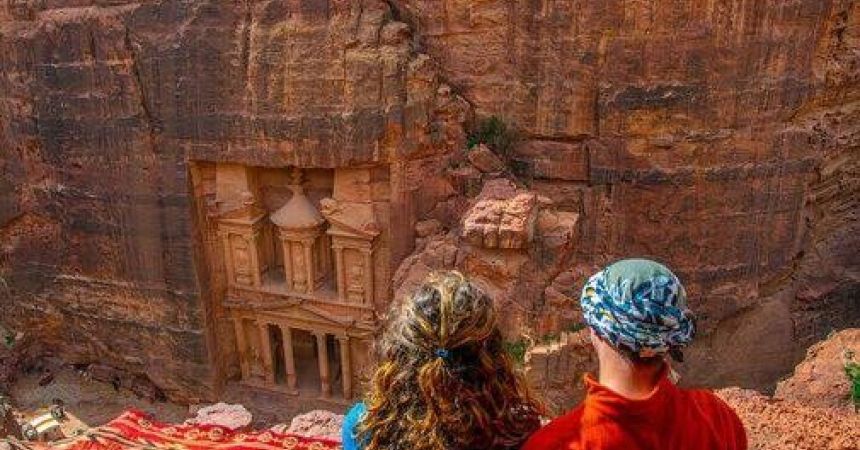
Because the Treasury is reached relatively early in the visit, travelers sometimes imagine Petra as something that can be “done” during a morning. Technically, you can enter through the Siq, see Al-Khazna and leave again.
What you have experienced, however, is the introduction.
Beyond the Treasury, the archaeological landscape continues through tombs, public architecture, religious structures, urban remains and routes that reveal how much larger the Nabataean city was than its famous façade suggests.
An April Petra full-day visit works best when you remove the psychological deadline of needing to finish before lunch.
Give the site room to unfold.
A Full Day Does Not Mean Walking Continuously
This distinction is crucial.
April's comfortable spring conditions can tempt visitors into using every pleasant hour for movement. Because you are neither fighting winter cold nor managing intense summer heat, it becomes remarkably easy to continue walking simply because nothing is forcing you to stop.
Petra becomes better when you do.
Pause in front of a façade without immediately reaching for the next location on your map. Sit somewhere appropriate and look across the landscape. Allow lunch to interrupt the route properly rather than consuming something quickly because you want to keep moving.
A long Petra day should contain empty spaces between its major moments.
Without them, eight hours can feel more rushed than four.
Think in Chapters Rather Than Kilometres
A useful April itinerary can be mentally divided according to how the archaeological city reveals itself.
The first chapter is arrival and anticipation: the entrance route and the Siq.
The Treasury provides the famous reveal, but rather than treating it as the climax, consider it the point where the second chapter begins. Beyond it, Petra opens physically and historically, giving you more room to understand tomb architecture and the wider urban landscape.
Later sections shift the experience again toward public, religious and civic remains.
This way of organizing the visit creates something a distance-based itinerary cannot.
Narrative.
You are no longer walking 3 kilometres and then another 2 kilometres.
You are moving through different versions of Petra.
Where Should Your Energy Go?
April is not about conserving every step. It is about spending those steps deliberately.
| Part of the Experience | Energy Demand | Why It Deserves Time |
|---|---|---|
| Entrance and Siq | Moderate | Establishes Petra's landscape and engineering |
| Treasury area | Low–moderate | Major monument worth observing beyond the photograph |
| Central archaeological corridor | Moderate | Reveals Petra as an urban center |
| Tombs and side areas | Variable | Adds architectural and cultural depth |
| Major route extension | High | Can transform the day but adds substantial effort |
| Return journey | Often underestimated | Remains part of the Petra experience |
Unlike March's table, this is not asking how far conditions allow you to expand.
April's question is where a full day's finite energy creates the greatest archaeological return.
Don't Spend All Your Attention at the Treasury
Physical energy is only one resource.
Attention is another.
The Treasury arrives so early and carries so much cultural recognition that visitors naturally invest enormous emotional energy there. Photographs are taken, angles are changed, details are examined, and for a while it can feel difficult to leave.
There is nothing wrong with that.
But Petra contains enough visual and historical complexity that preserving curiosity for what comes afterward matters.
A spring Petra heritage day becomes considerably richer when the Treasury remains a highlight without consuming the entire psychological center of the visit.
Some of the most interesting discoveries happen once you are no longer searching for an image you already recognize.
April Lunch Should Divide the Story
Lunch during a full Petra day deserves more than a nutritional role.
It can become the natural dividing point between the first and second half of the visit.
Before lunch, you are usually moving deeper into the archaeological landscape, absorbing large amounts of new information and gradually accumulating distance. A proper stop gives your legs and attention time to reset before deciding how ambitious the later part of the day should become.
This is different from summer, when a break may primarily manage heat exposure.
April lunch is about restoring curiosity.
If you return to the route physically refreshed but mentally tired, slow the second half rather than adding another major objective automatically.
The Most Ambitious Option Is Not Automatically the Best One
Pleasant weather can create pressure to take advantage of it.
“If conditions are this good, shouldn't we do everything?”
Not necessarily.
A major extension can be one of the day's highlights when it matches your interests and physical ability. It can also dominate the itinerary so completely that several archaeological areas become places you hurry through on the way somewhere else.
Decide according to what you value.
Travelers fascinated by Nabataean urbanism may prefer spending more time around the central archaeological areas. Someone motivated by monumental architecture and landscape may willingly devote substantial energy to a farther destination.
April gives you options.
It does not tell you which option you must choose.
Good Weather Should Make You Slower Occasionally
There is an unexpected benefit to a comfortable April day: you can afford to waste a little time.
Not genuinely waste it, of course.
You can sit without needing shade urgently. You can remain with an interesting archaeological detail without worrying that the entire schedule will collapse. You can let a guide's explanation run longer because you are not desperate to reach the next stop before conditions become uncomfortable.
For travelers taking an April Petra discovery, these unscheduled minutes often become the difference between touring an archaeological site and actually absorbing one.
Leave Something for the Walk Out
Late in the day, Petra can reveal whether the itinerary was well paced.
If the return feels like an obstacle separating you from the hotel, you probably spent too much energy reaching the farthest point.
If you can still notice the landscape, stop briefly and appreciate the Siq differently on the way back, the day's balance was probably better.
April's moderate conditions make a long visit possible, but they do not make the site physically smaller.
The return remains real.
Plan enough energy for it.
April Owns the Complete Petra Day
March was about range returning after winter and deciding whether conditions justified going farther.
April changes the emphasis entirely.
The site no longer needs to be approached primarily as a route that might expand. Instead, it can become a full-day archaeological narrative, with periods of walking, observation, rest and deeper exploration arranged around what genuinely deserves your attention.
May will introduce a different problem as stronger sunshine begins affecting exposed walking.
April stays before that threshold.
Its exclusive search intent is simpler and more human:
How do you spend an entire spring day inside Petra without turning one of the world's great archaeological landscapes into an endurance challenge or a checklist?
By giving the city time, but refusing to confuse time with speed.
The Second Half of the Day Should Not Be a Copy of the First
A well-paced April visit changes character as the hours pass.
During the earlier part of the day, curiosity naturally pulls you forward. Everything is new, the famous monuments are still appearing for the first time, and walking deeper into Petra feels effortless because the route continues revealing something ahead.
After several hours, that momentum deserves to soften.
Instead of treating the afternoon as another sightseeing block requiring the same pace, use it for greater selectivity. Perhaps one archaeological area deserves more attention than expected, or perhaps you decide that a substantial extension matters more than several smaller stops. You may simply discover that sitting for twenty minutes and looking across Petra gives you more than immediately continuing.
A full day works because it has different rhythms, not because you maintain maximum productivity from entrance to exit.
Give One Part of Petra More Time Than It Apparently Deserves
Maps and guidebooks naturally direct attention toward named monuments, but memorable visits often contain a place where you unexpectedly linger.
It could be a group of tombs you had barely researched, architectural remains that help you understand the city differently, or simply a position from which Petra's relationship with the surrounding mountains suddenly becomes clearer.
Allow that to happen.
One of April's advantages is that moderate conditions can provide enough flexibility to let an unplanned forty minutes remain unplanned. You do not always need to recover that time by walking faster afterward.
This is also one of the strongest ways to make a Petra visit feel personal. Thousands of visitors may follow broadly similar routes, yet they do not all need to experience those routes at the same speed or attach importance to exactly the same places.
Decide on the Major Extension After You Know How the Day Feels
If your plans include a physically demanding extension, you do not necessarily need to make the final decision before entering Petra.
See how the day develops first.
By the time you have spent several hours walking, you will understand your energy far better than you did over breakfast. You will also know whether you are enjoying a slower archaeological experience or feel genuinely enthusiastic about extending the route.
A useful April decision can therefore be remarkably simple:
| By Midday You Feel… | Sensible Direction |
|---|---|
| Energetic and curious | Consider the planned major extension |
| Comfortable but absorbed by central Petra | Stay longer rather than forcing extra distance |
| More tired than expected | Reduce ambition while the day is still enjoyable |
| Interested in one particular area | Give that interest priority over the checklist |
| Unsure about conditions or access | Confirm locally before extending the route |
The table is intentionally about midday decision-making inside a full archaeological day, rather than another monthly weather comparison.
Photography Can Quietly Consume the Day
Petra invites photography constantly.
The difficulty is not taking photographs; it is recognizing when photographing every variation of a scene begins replacing the experience itself.
April's longer, more comfortable archaeological day can encourage visitors to believe there is unlimited time, particularly during the morning. Twenty minutes at one façade, another twenty waiting for a particular composition and repeated stops along the route gradually accumulate.
Choose where photography matters most to you.
At other moments, put the phone or camera away and walk through Petra without trying to convert every view into something to keep. The archaeological city has scale, sound, texture and spatial relationships that photographs reproduce only partially.
A Full Day Requires Mental Rest Too
Physical fatigue is obvious because your legs tell you about it. Archaeological fatigue is quieter.
After several hours of tombs, façades, temples and historical explanation, extraordinary things can begin looking strangely ordinary. Another monument appears and, instead of curiosity, your first thought becomes how far away it is.
That is a good moment to stop.
Have something to drink, eat if appropriate, or simply sit somewhere permitted without consuming more information. A twenty-minute mental reset can restore enough attention for the final part of Petra to feel significant again.
April's full-day opportunity is valuable only if you remain interested enough to appreciate it.
Finish With Petra, Not With Exhaustion
The final walk toward the exit should not feel like an administrative task.
As you return through familiar sections, the site has changed because you now understand its scale differently. The Treasury is no longer the mysterious destination waiting beyond the Siq; it has become one monument within a much larger city you have spent the day exploring.
The Siq can also feel different in reverse. Without anticipation pulling you toward Al-Khazna, details in the gorge that escaped attention earlier may become easier to notice.
Leave enough physical and mental space for that final experience.
A properly paced April day should make you tired.
It should not make you desperate to leave.
12 Questions About Visiting Petra in April
1. What is the weather like in Petra in April?
April generally brings mild to warm spring daytime conditions, although individual days can vary and cooler mornings or occasional unsettled weather remain possible. The season often supports extended outdoor exploration, but visitors should still check the short-range forecast before deciding how ambitious the day should become.
2. Is Petra warm in April?
Daytime conditions can feel pleasantly warm, particularly in sunshine and during sustained walking, while mornings may be noticeably cooler. Rather than dressing for one expected temperature, choose adaptable clothing that remains comfortable across several hours of physical activity.
3. Does it rain in Petra in April?
Rain remains possible even though April is moving farther away from the wetter winter period. Check conditions for your actual dates and follow current site guidance whenever weather affects access rather than assuming a typical April pattern guarantees a completely dry visit.
4. What should I wear to Petra in April?
Comfortable walking clothing with removable layers usually provides useful flexibility. Supportive footwear remains essential because Petra involves substantial distances and uneven surfaces, while water, sunglasses and sensible sun protection become increasingly relevant as spring sunshine strengthens.
5. Is April suitable for spending a full day in Petra?
April conditions can support a long archaeological day when the weather is settled, making it possible to combine the main route with deeper exploration and proper rest periods. Your actual itinerary should still reflect fitness, interests, access conditions and available daylight.
6. How should I pace a full day in Petra?
Avoid walking continuously simply because conditions feel comfortable. Give important monuments enough attention, take a genuine break around the middle of the day, and decide on demanding extensions only after assessing how much physical and mental energy remains.
7. Should I visit the Monastery during an April trip?
Include a major extension when it genuinely matches your interests, available time and physical ability. April's generally comfortable walking environment can make ambitious exploration appealing, but there is no benefit in reaching another monument if doing so forces you to rush through everything else.
8. How much water should I carry in April?
Your needs depend on temperature, route length and personal requirements, but substantial walking means hydration remains important even when the weather feels mild. Carry enough water for your planned route and make drinking part of the day rather than waiting until you feel particularly thirsty.
9. Can I see Petra properly in only a few hours?
A short visit can introduce the Siq, Treasury and part of the archaeological landscape, but Petra extends considerably beyond its iconic entrance sequence. April is particularly suited to allowing more time so the site can develop from famous monument into understandable ancient city.
10. Should I plan every hour of my Petra day?
A basic structure is useful, but excessive scheduling works against Petra's character. Leave enough flexibility to spend longer somewhere unexpectedly interesting, rest when your attention begins fading and modify later plans according to how the day actually develops.
11. Why does the return journey matter when planning Petra?
Every extension adds distance that eventually needs to be covered again, often after several hours of walking. Preserving energy for the return allows you to continue noticing the archaeological landscape instead of treating the final section merely as the way back to the exit.
12. What makes April different from March in Petra?
March focuses on the return of walking range after winter, when visitors begin extending their archaeological exploration more confidently as spring develops. April owns the complete Petra day: balancing monuments, walking, rest, attention and optional extensions so that many hours inside the ancient city form one coherent experience rather than a race to cover maximum distance.

A travel professional specializing in tailor-made travel planning, guest experience management, and multi-destination tourism operations.
With over 23 years of experience in the travel industry, he designs and manages private and cultural tours for international travelers across Türkiye, Greece, Egypt, Jordan, Morocco, and other destinations.
He has strong expertise in both online and face-to-face guest communication, sales processes, and end-to-end travel operations.
Working closely with hotels, travel agencies, and local partners, he ensures smooth coordination and high-quality travel experiences at every stage of the journey.
His focus is on delivering personalized, reliable, and seamless travel experiences for international guests worldwide.
