
Family-Friendly Travel Guide to Turkey with Kids
Updated: August 2026
Turkey can be an unusually rewarding country for a family trip because children do not have to experience it entirely through museums and monuments. A morning in Istanbul might involve crossing the Bosphorus by ferry, Cappadocia introduces landscapes that look almost imaginary, Ephesus turns ancient history into something physically walkable, and coastal Turkey offers a completely different pace when everyone needs a break from sightseeing.
The challenge is not finding enough places to take children. It is deciding how much Turkey a family should attempt on one journey.
An itinerary that works beautifully for two adults can become exhausting when a seven-year-old is expected to wake before sunrise, tour archaeological sites for hours, take an afternoon flight and begin again the following morning. Conversely, reducing every day to children's entertainment can prevent parents and older children from experiencing the history and culture that made Turkey worth traveling to in the first place.
Successful family travel sits between those extremes. The objective is to design a journey in which Turkey remains Turkey, while the pace acknowledges that you are traveling as a family.
Start With Your Children's Travel Age, Not Their Passport Age
Two families traveling with eight-year-olds can need completely different itineraries.
One child may happily walk through Ephesus listening to stories about Roman life, while another loses interest after an hour in the heat. A teenager fascinated by history may want considerably longer at Topkapı Palace than a parent expects. A child accustomed to international travel may handle a domestic flight effortlessly, while another finds every hotel change disruptive.
Rather than planning around age alone, consider four practical characteristics:
| Family factor | Ask yourself | Why it matters in Turkey |
|---|---|---|
| Walking tolerance | How long can they comfortably explore on foot? | Istanbul and archaeological sites involve substantial walking |
| History tolerance | Do stories and ruins hold their attention? | Determines how densely to schedule cultural visits |
| Transfer tolerance | How well do they handle flights and hotel changes? | Turkey's major regions are geographically spread out |
| Routine flexibility | How important are regular meals and sleep? | Early starts and long touring days can accumulate fatigue |
| Novelty appetite | Do new environments energize or overwhelm them? | Markets, cities, caves and local experiences can be stimulating |
This is more useful than declaring that Istanbul is “best for children aged 6+” or Cappadocia is “perfect for all ages.” Families are rarely that predictable.
Istanbul Works Best When Children Experience the City Between the Monuments
Istanbul contains some of Turkey's most important historical entities: Hagia Sophia, Topkapı Palace, the Blue Mosque, Basilica Cistern and the ancient Hippodrome all sit within a relatively concentrated area.
That geographical convenience can tempt parents to schedule them consecutively.
The result may be historically impressive and emotionally disastrous by mid-afternoon.
With children, Istanbul often works better when the movement between major sites becomes part of the experience. A ferry crossing gives everyone a change of environment. Walking through a neighborhood introduces bakeries, street life and ordinary Istanbul between formal visits. The Basilica Cistern offers a completely different sensory experience from another museum gallery.
Even public transportation can add variety. Ferries, trams and the city's constant relationship with the Bosphorus help prevent Istanbul from becoming a sequence of buildings children are expected to admire because adults tell them they are important.
The principle is simple: do not remove cultural sightseeing; change its rhythm.
Build Family Days Around One Major Commitment
One of the easiest ways to improve a Turkey family itinerary is to identify the day's principal experience.
That might be Topkapı Palace in Istanbul, an underground city in Cappadocia or Ephesus near Kuşadası. Other activities can surround it, but they should not all carry equal weight.
Adults frequently tolerate “one more site” surprisingly well. Children often experience that extra stop as the moment the entire day becomes too long.
A useful family planning model is:
one major experience + lighter secondary activity + unstructured margin
The margin matters. It absorbs a longer lunch, an unexpected rest, traffic, a child who suddenly needs food or a place everyone enjoys more than anticipated.
A good family itinerary does not need to use every available hour.
Cappadocia Can Be Wonderful Without Making the Balloon the Whole Story
Cappadocia is one of Turkey's strongest family destinations because the landscape itself creates curiosity. Fairy chimneys, valleys, rock formations and cave architecture provide visual interest before a guide explains anything.
The underground cities can also be memorable for older children who enjoy exploring unusual spaces, although parents should consider individual comfort with narrow passages, stairs and enclosed environments.
Hot-air ballooning requires more careful planning. Cappadocia's balloons are weather-dependent and operate early in the morning, while participation requirements and operator conditions need to be checked for children rather than assumed.
Families should therefore avoid designing the emotional success of Cappadocia around one balloon flight.
If weather prevents flying, the destination should still feel worthwhile.
That is easier when children understand that Cappadocia itself—not simply the photograph from above—is the experience.
Families wanting Istanbul and Cappadocia within a structured program can compare Turkey family adventure tours when considering how flights, accommodation and sightseeing can be connected without making this guide itself a commercial itinerary.
The Real Family Question Is How Often You Want to Pack
Turkey is a large country.
Istanbul, Cappadocia, Ephesus, Pamukkale and Antalya can be connected efficiently through combinations of domestic flights and road transportation, but efficient does not mean effortless when traveling with children.
Every relocation contains several invisible tasks: packing, checking out, reaching an airport or meeting a vehicle, managing luggage, traveling, arriving, checking in again and re-establishing the family's routine.
Adults often calculate only the flight time.
Parents should calculate the transition cost.
What an additional destination really adds
| On the itinerary | What the family experiences |
|---|---|
| “Flight to Cappadocia” | Checkout + airport transfer + airport + flight + arrival transfer + check-in |
| “Drive to Pamukkale” | Packing + road journey + stops + new hotel + changed routine |
| “Add Antalya” | Another transfer cycle before the beach stay begins |
| “One extra hotel” | Another unpack/repack process for the entire family |
For families, removing one destination can sometimes improve the journey more than adding an extra free afternoon.
Ephesus Works When Ancient History Becomes Human
Children do not necessarily dislike archaeological sites. They often dislike archaeological explanations designed exclusively for adults.
Ephesus becomes much more accessible when children can imagine people actually living there.
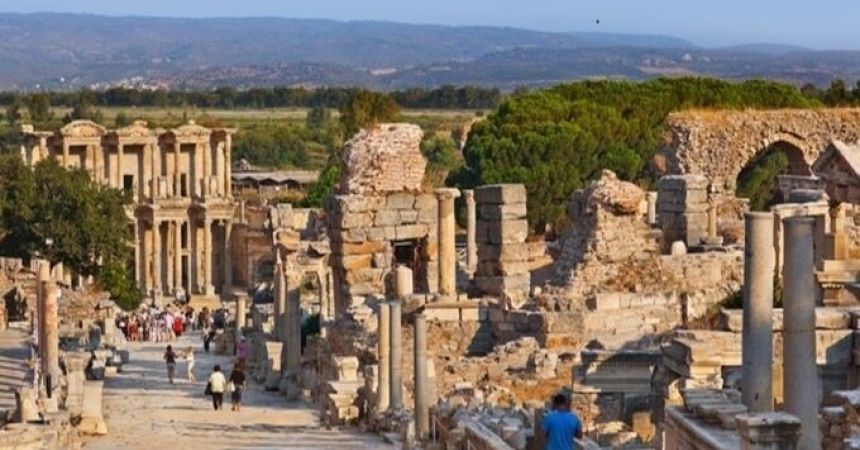
Instead of presenting only dates and emperors, a good family visit can draw attention to streets, houses, public spaces, the Library of Celsus and the scale of the ancient city. Questions such as “Where did people shop?” or “How did thousands of people live here?” make ruins less abstract.
Footwear and timing also matter because Ephesus is an outdoor archaeological site with uneven ancient surfaces and limited shade in exposed areas.
Families interested in combining western Turkey's archaeological heritage with other regions can review Turkey cultural discovery trips as a route reference, while keeping the family guide focused on how children experience those destinations rather than prescribing a fixed itinerary.
Pamukkale Needs Different Expectations
Pamukkale creates an interesting family-planning decision because its visual appeal is immediate. White travertine terraces are easier for a child to respond to instinctively than another archaeological complex.
Yet Pamukkale also contains Hierapolis, which gives parents an opportunity to combine landscape and history within the same destination.
The mistake is assuming that because the photographs look playful, the entire visit functions like a swimming-pool day.
Families should prepare children for walking, changing surfaces and the archaeological component rather than presenting Pamukkale only as somewhere to play in water.
This distinction may sound small, but setting expectations before a visit is one of the easiest ways to reduce disappointment when traveling with children.
Use the Coast as a Change of Pace, Not a Reward for Surviving History
If a Turkey journey includes Antalya or another coastal stay, avoid presenting it to children as the reward they receive after enduring cultural sightseeing.
That creates the wrong relationship with the rest of the trip.
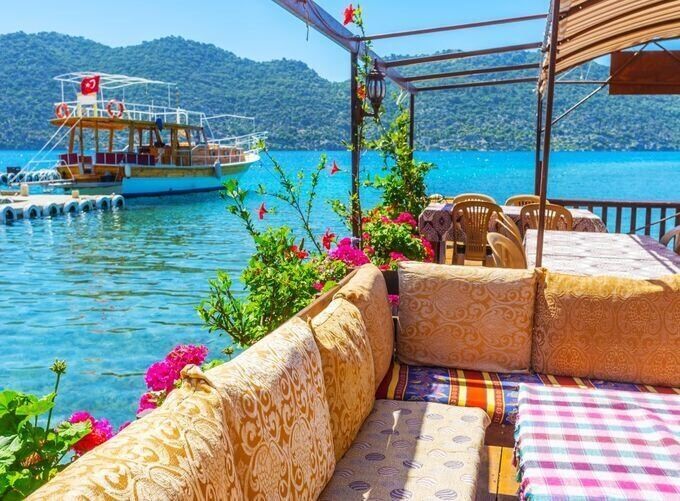
Instead, think of the coast as a deliberate change in travel rhythm. Istanbul provides urban energy, Cappadocia landscape, Ephesus archaeology, while the Mediterranean coast can provide slower days and fewer scheduled commitments.
This contrast can be especially valuable on longer family journeys.
Parents sometimes schedule the relaxed portion too tightly as well, filling beach destinations with boat trips, excursions and activities every day. If the purpose of adding the coast was recovery, allow some recovery to happen.
Food Is Usually Easier Than Parents Expect
Turkey offers a broad range of foods that can work well for families without requiring children to immediately embrace unfamiliar dishes.
Fresh bread, rice, grilled meats, köfte, pide, soups, yogurt, fruit and simple breakfast items give less adventurous eaters recognizable options, while more curious children can gradually explore regional dishes.
Breakfast can be particularly useful because Turkish hotel breakfasts commonly offer multiple components rather than a single fixed dish, allowing families to build meals around individual preferences.
Rather than searching constantly for explicitly “children's food,” introduce unfamiliar dishes alongside something recognizable.
This approach makes Turkish food part of the travel experience without turning every meal into a negotiation.
Private and Small-Group Touring Solve Different Family Problems
There is no universal rule that families should always travel privately.
Private sightseeing offers flexibility. A guide can adjust the pace, shorten a visit when children are tired or spend longer somewhere that unexpectedly captures their attention. Families with younger children may value this considerably.
Small-group touring can offer better value and may suit older children or teenagers who travel comfortably within a schedule.
The decision should depend less on luxury and more on how much control your family needs over time.
| Family profile | Touring style that may fit |
|---|---|
| Younger children / variable energy | Private touring provides flexibility |
| Older children comfortable with schedules | Small group can work well |
| Several generations traveling together | Private pace can simplify different mobility needs |
| Highly independent family | Transfers + selected guided visits may be enough |
| History-focused teenagers | Quality of guide may matter more than group format |
This is also where an experienced local operator can add value: not by claiming every activity is “family-friendly,” but by recognizing when the sequence itself needs adjustment.
Do Not Underestimate Heat, Water and Walking
Turkey's conditions vary greatly by region and season, and this article deliberately does not replace the site's weather or best-time content.
The family-specific issue is that children may respond to environmental conditions faster than adults.
At exposed archaeological sites, practical preparation matters: suitable footwear, water, sun protection and realistic walking expectations can determine whether a visit remains enjoyable. In Istanbul, a day that looks geographically compact may still involve substantial time on foot.
Parents should also resist the temptation to continue simply because the scheduled program says another site remains.
Missing one minor visit is usually preferable to making everyone dislike the final three hours of the day.
Teenagers Need Ownership, Not a Children's Version of Turkey
Family travel advice often focuses so heavily on younger children that teenagers become an afterthought.
The solution for teenagers is rarely to make everything more childish.
Give them some ownership instead.
Allow an older child to choose a restaurant, select between two optional experiences, take responsibility for navigating a ferry journey or research the story behind a particular site before arrival. Cappadocia, Istanbul's neighborhoods, food culture and archaeological sites can all become considerably more interesting when teenagers participate in the decision-making.
A family trip works better when children are not merely passengers in an adult itinerary.
For families planning a broader journey with several major regions, Turkey multi-city tours can provide a commercial reference for possible route structures before deciding how much of that structure genuinely suits the children's pace.
A Family-Friendly Turkey Trip Should Still Feel Like Turkey
This is perhaps the most important principle.
Making Turkey family-friendly does not require replacing Hagia Sophia with amusement parks, avoiding archaeological sites or constructing the holiday entirely around children.
It means presenting real Turkish experiences at a pace the family can absorb.
Cross the Bosphorus. Explore Cappadocia's strange geology. Walk ancient streets at Ephesus. Try unfamiliar food alongside familiar choices. Let children ask questions that are not on the guide's normal script. Allow a hotel afternoon when everyone needs one.
The strongest family itineraries are not those containing the greatest number of child-specific activities.
They are the ones where parents and children return home feeling they experienced the same country together.
Frequently Asked Questions About Visiting Turkey With Kids
1. Is Turkey suitable for a first international trip with children?
Turkey can work very well for internationally traveling families because major tourism regions offer established hotels, transportation and guided sightseeing alongside highly varied experiences. The key is keeping the itinerary selective enough that children are not constantly recovering from another transfer or hotel change.
2. Will children get bored visiting Istanbul's historical sites?
They can if several monuments are presented consecutively as adult history lessons. Mixing major sites with ferry journeys, neighborhood walks, food stops and visually different experiences such as the Basilica Cistern can make Istanbul's cultural content considerably easier for children to absorb.
3. How many major sightseeing activities should we schedule in one day?
For many families, one substantial visit surrounded by lighter activities works better than scheduling three equally demanding attractions. Children's age, interests and travel experience vary, so leave enough flexibility to shorten a day without feeling that the itinerary has failed.
4. Is Cappadocia worthwhile with children if we cannot take a balloon flight?
Absolutely. Cappadocia's valleys, rock formations, cave architecture and unusual landscape provide plenty of interest independently of ballooning. Treat a flight as one possible experience rather than the destination's entire purpose, particularly because balloon operations depend on weather and operating conditions.
5. Are underground cities in Cappadocia appropriate for every child?
Not necessarily. Narrow passages, stairs and enclosed spaces may be exciting for some children and uncomfortable for others. Parents should consider mobility and reactions to confined environments before entering rather than assuming that an attraction described as family-friendly will suit every child.
6. How can we make Ephesus more interesting for younger travelers?
Focus on how people lived rather than overwhelming children with chronology. Streets, homes, public buildings and the Library of Celsus provide opportunities to imagine everyday ancient life. A guide comfortable engaging families can also adapt explanations without reducing the site's historical significance.
7. Should a family choose private tours or small-group sightseeing in Turkey?
Neither is automatically better. Private touring provides greater control over breaks and pace, while small groups can suit families with older children who manage schedules comfortably. Consider how frequently your family needs flexibility rather than choosing solely according to price or perceived luxury.
8. Is it better to fly or drive between Turkey's main destinations with children?
It depends on the route. Domestic flights can reduce long-distance travel time, while road transport is practical for certain regional connections. Families should compare the complete door-to-door journey, including airports and transfers, rather than looking only at the scheduled flight duration.
9. What should parents know about food for picky eaters in Turkey?
Simple options such as bread, rice, grilled foods, köfte, pide, yogurt and fruit are widely familiar in flavor and texture, making gradual experimentation easier. Offering a new dish alongside something recognizable usually works better than searching exclusively for international children's menus.
10. How many hotel changes are reasonable on a family trip?
There is no universal number, because children tolerate transitions differently. However, if most mornings involve packing and departure, reconsider the route. Spending an additional night in fewer places often creates more usable family time than adding another destination simply because transportation permits it.
11. Is Turkey enjoyable for teenagers as well as younger children?
Yes, particularly when teenagers participate in decisions rather than receiving a simplified children's itinerary. Food, photography, ancient history, Cappadocia, Istanbul neighborhoods and coastal experiences offer different points of engagement, while allowing teenagers some choices gives them greater ownership of the journey.
12. What is the most important rule when planning Turkey with children?
Design the trip around shared experiences rather than maximizing the number of places visited. Turkey rewards curiosity, but repeated transfers and overloaded sightseeing days can overwhelm that advantage. Protect flexibility so the family can respond naturally when energy, interests or circumstances change.

A travel professional specializing in tailor-made travel planning, guest experience management, and multi-destination tourism operations.
With over 23 years of experience in the travel industry, he designs and manages private and cultural tours for international travelers across Türkiye, Greece, Egypt, Jordan, Morocco, and other destinations.
He has strong expertise in both online and face-to-face guest communication, sales processes, and end-to-end travel operations.
Working closely with hotels, travel agencies, and local partners, he ensures smooth coordination and high-quality travel experiences at every stage of the journey.
His focus is on delivering personalized, reliable, and seamless travel experiences for international guests worldwide.
